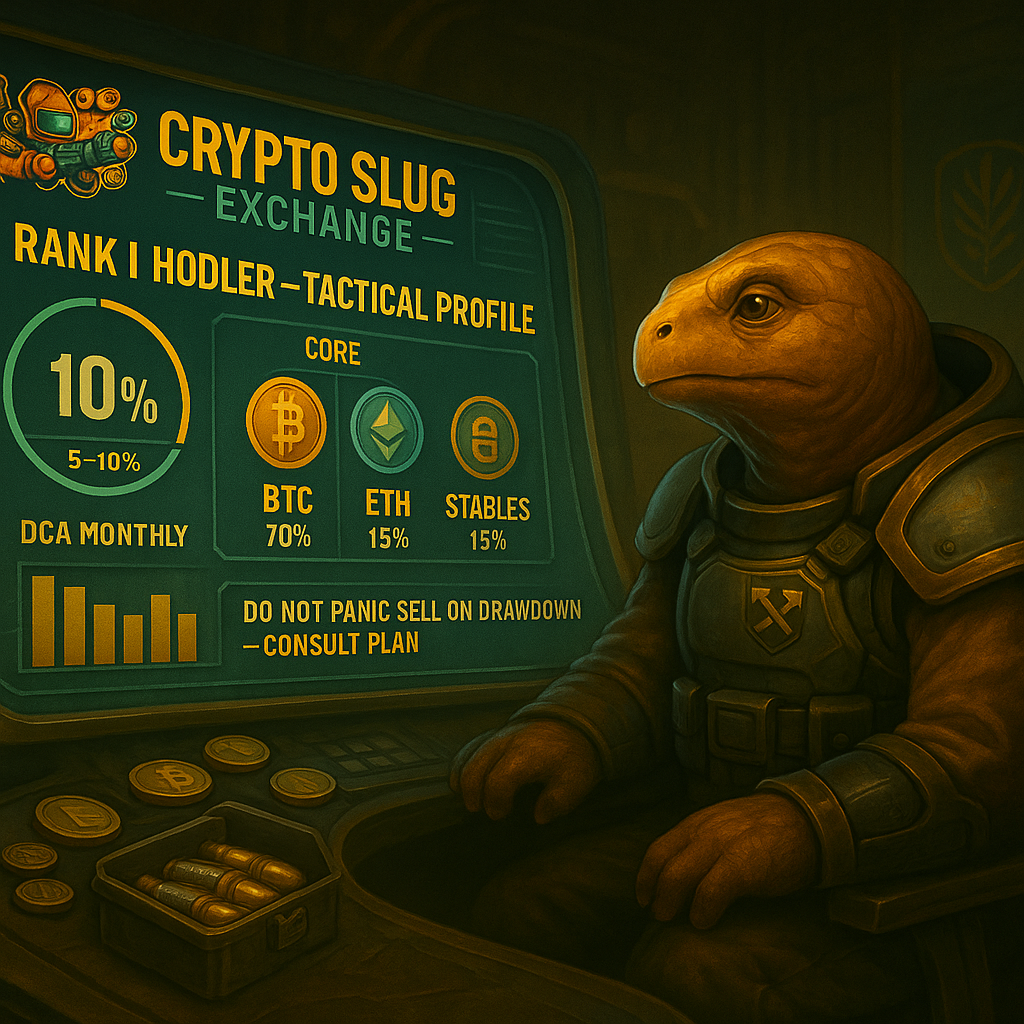
1. Why risk management comes before “making money” ⚠️
Before you think about APR, APY, DCA, bots or “pro” strategies, there’s a basic question:
How much can you lose without blowing up your plan?
Risk management here is not an Excel formula. It’s deciding up front:
- How much money can go into crypto 🧱
- How much you can see drop without panicking 📉
- How long you can stay exposed ⏱️
Without this, any strategy — even a good one — can fail because you can’t handle the path.
2. What “risk” means for a hodler (not just volatility) 🎢
When you look at a chart, you see candles going up and down. But for you, as a person, risk is something else:
- Liquidity risk: using money you’ll need for bills/rent in the next few months.
- Behaviour risk: selling at the worst moment because you can’t stomach the drop.
- Concentration risk: being too loaded into 1 or 2 assets.
- Product risk: entering stuff you don’t understand (DeFi, loans, complex products).
To simplify, let’s think of risk in 3 dimensions:
- Amount – how much you have in there 💰
- Drawdown – how much you can see drop without breaking 💥
- Time – how long you can wait without needing that money ⏳
Everything else (APY, strategies, etc.) spins around this.
3. Position size: how much money can go in? 💸
First, the obvious thing most people ignore:
Money you’ll need in the next 6–12 months does not go into crypto. Period.
For a hodler in the basic phase, you can think like this:
- Define a fixed monthly amount that feels comfortably safe.
Example: “I can put 50 €/month without breaking anything in my life.” - Define a maximum cap for crypto exposure, like:
“In total I want to stay between 5% and 10% of my net worth.”
If you catch yourself thinking:
- “If this goes wrong I don’t know how I’ll pay X…”
→ your position size is wrong.
- Does this money pay rent/food/bills? → Then it doesn’t go in.
- If this drops 50%, will I need to touch it? → if yes, you’re risking too much.
- If you couldn’t add more money to crypto for 1 year, could you live with that?
4. Drawdowns and recovery time: the boring maths no one wants to see 📉➡️📈
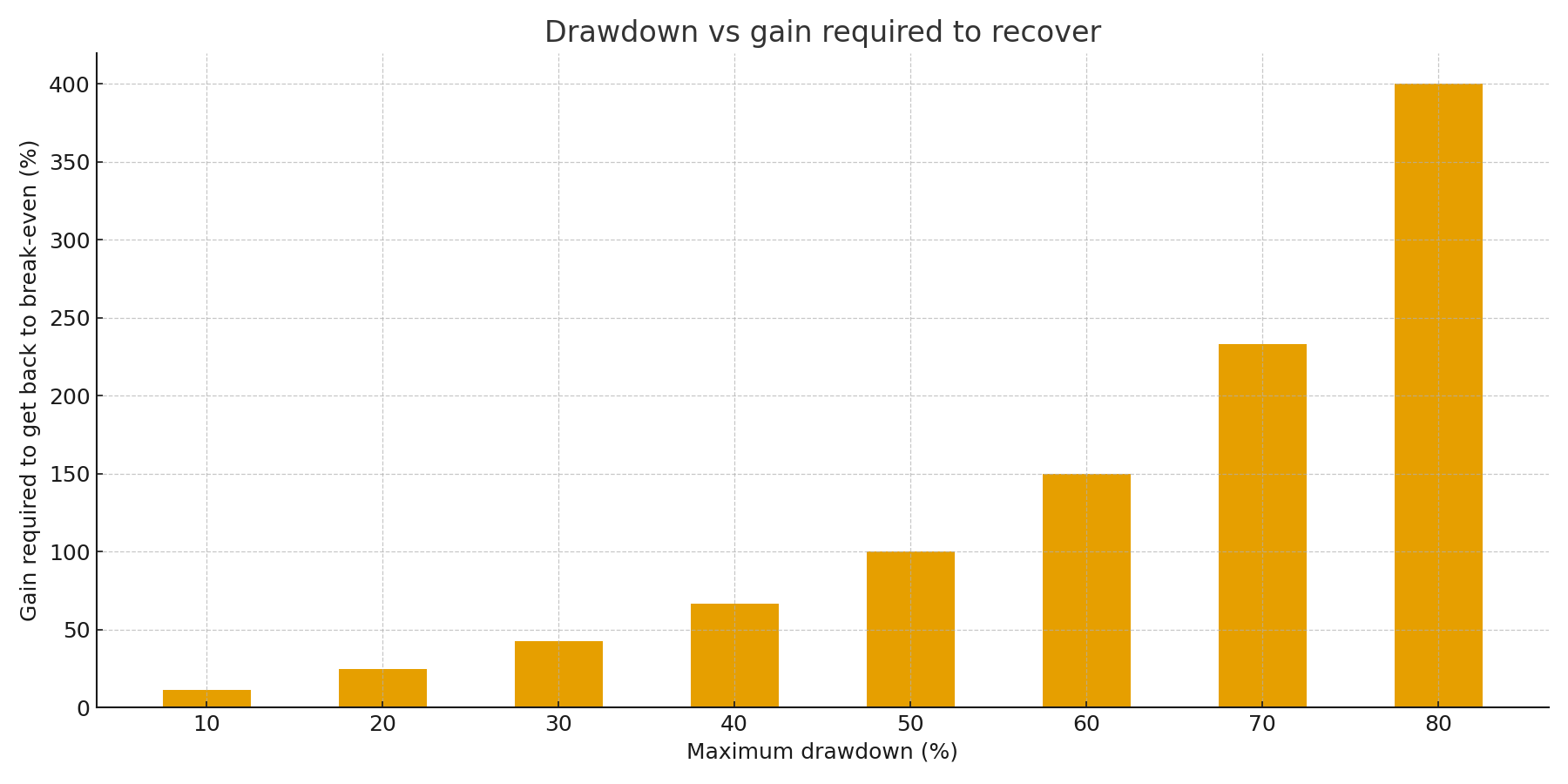
Here comes the first chart:
Chart 1 — Drawdown vs required recovery
risk-drawdown-recovery-en.png
Idea:
- X axis: maximum drawdowns (−10%, −20%, −30%, −40%, −50%, −60%, −70%, −80%).
- Y axis: gain required to get back to zero (+11%, +25%, +43%, +67%, +100%, +150%, +233%, +400%).
What this shows:
- A −10% drop needs +11% to recover.
- A −50% drop needs +100% to get back to the starting point.
- A −80% drop needs +400% just to break even.
In other words:
The bigger the drawdown, the heavier the climb you need.
This matters especially for:
- Altcoins that can drop 70–90% and never come back.
- Late entries in bull markets, where you buy near the top.
This chart exists to remind you:
- You don’t want to live permanently in “recovering losses” mode.
- It’s better to avoid extreme drawdowns than to force the future to heal the present.
5. Single-asset risk vs portfolio risk 🧺
It’s not just “how much you have in crypto”, it’s how it’s distributed:
Single-asset risk:
- How much you have in BTC, ETH, stablecoins, altcoins.
Portfolio risk:
- If the market drops 60%, how much is that in euros in your real life?
For Rank I, a simple scheme (example, not a hard rule):
- 60–80% in BTC/ETH (core).
- 0–20% in altcoins (optional bets, always small).
- 0–20% in stablecoins (airbag / future ammo).
This helps avoid the classic:
“I’m 90% in one altcoin I saw in a 30-second video.”
6. Position size and impact in euros (not just percentages) 💥
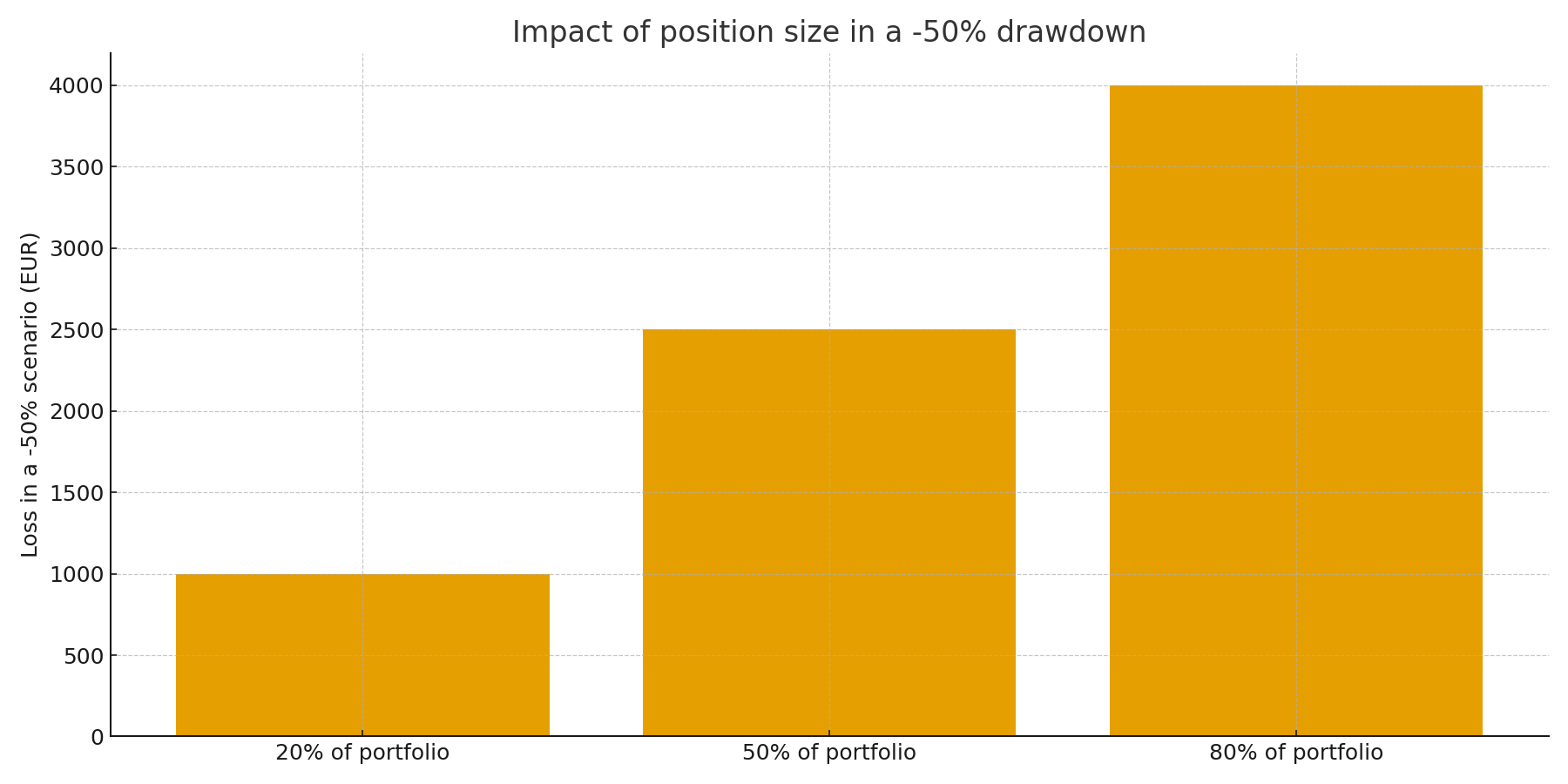
Second chart in the article:
Chart 2 — Impact of position size in a -50% drawdown
risk-position-size-en.png
Setup:
- Assume a portfolio of €10,000.
- Compare 3 scenarios in an asset that drops −50%:
- Position of 20% of the portfolio → €2,000 exposed.
- Position of 50% of the portfolio → €5,000 exposed.
- Position of 80% of the portfolio → €8,000 exposed.
Loss in each scenario:
- 20% position → −€1,000 (−10% of the total portfolio).
- 50% position → −€2,500 (−25% of the total).
- 80% position → −€4,000 (−40% of the total).
The chart shows the gut punch in euros:
- The same −50% drawdown in the asset produces completely different pain just because of position size.
This forces a key question:
“If this drops 50%, will this euro amount ruin my sleep?”
7. Product risk: spot, Earn, DeFi, loans 🧪
Not all risk comes from price. Some comes from the type of product you use:
- Simple spot (BTC/ETH on the spot market):
Price risk (up/down), but easy to understand. - Savings / Earn with stablecoins:
Stablecoin issuer risk + risk of the platform where it’s deposited. - L1 staking:
Protocol risk + asset price risk + possible lock-up periods. - DeFi yield farms / exotic pools:
Smart-contract risk, token risk, liquidity, peg, and often anon teams. - Loans / leverage:
Liquidation risk + interest + snowball effect if the market moves against you.
Sentence to pin on the wall:
“If I don’t understand where the yield comes from, the risk is probably me.” 🔍
8. Behaviour risk: you vs you 🧠
Even with a decent plan, the biggest risk is you:
- Going in heavy after a strong rally (FOMO).
- Dumping everything in a crash because “it’s going to zero” (panic).
- Changing strategies every week, without giving them time to prove anything.
Risk management is also:
- Choosing a position size that doesn’t force you to check the chart 30× a day.
- Defining beforehand:
- How much you’ll invest per month.
- What you’ll do if the market drops 50% (written down, not only in your head).
9. Mini risk management model for hodlers (Rank I) 🧱
Think of this as a “basic preset” you can adjust later:
Total exposure:
- Define a range for crypto, e.g. 5–10% of your total net worth.
Split by asset type:
- Core: 60–80% BTC/ETH
- Altcoins: 0–20% (max 2–3 projects, small positions)
- Stablecoins: 0–20% (airbag / ammo, not a toy).
Fixed monthly contribution:
- An amount you can keep for 6–12 months without stress (linked to the DCA Mission).
Declared emotional limit:
- Write something like:
“If the portfolio drops 50%, I don’t sell everything. I pause, review the plan and my decisions — not the 1-minute chart.”
Simple logging:
- Use the basic Hodler Diary or any sheet:
- Date, asset, amount, price, reason for the buy.
Every 3 months you review: total exposure, weight of each asset and how you felt during drawdowns.
10. Red list: what NOT to do 🚫
Some clear “don’ts” help keep your brain aligned when the market is on fire:
- ❌ Don’t use rent/bills money to buy crypto.
- ❌ Don’t put a big chunk of the portfolio in one “hot” altcoin.
- ❌ Don’t enter loans/leverage without a written plan, an airbag and experience.
- ❌ Don’t double your position just to “recover faster”.
- ❌ Don’t confuse “Twitter storytelling” with risk assessment.
11. Closing: your job is not to predict, it’s to survive 🪖
At the end of the day:
Your job as a hodler is not to nail the exact top or bottom. It’s to survive the cycles without blowing up your account or your head.
In practice, risk management is:
- Reducing the odds of making dumb decisions in extreme moments.
- Organising position size, the drawdowns you accept and the time you can wait.
- Making sure that when the next bull market shows up, you’re still in the game.