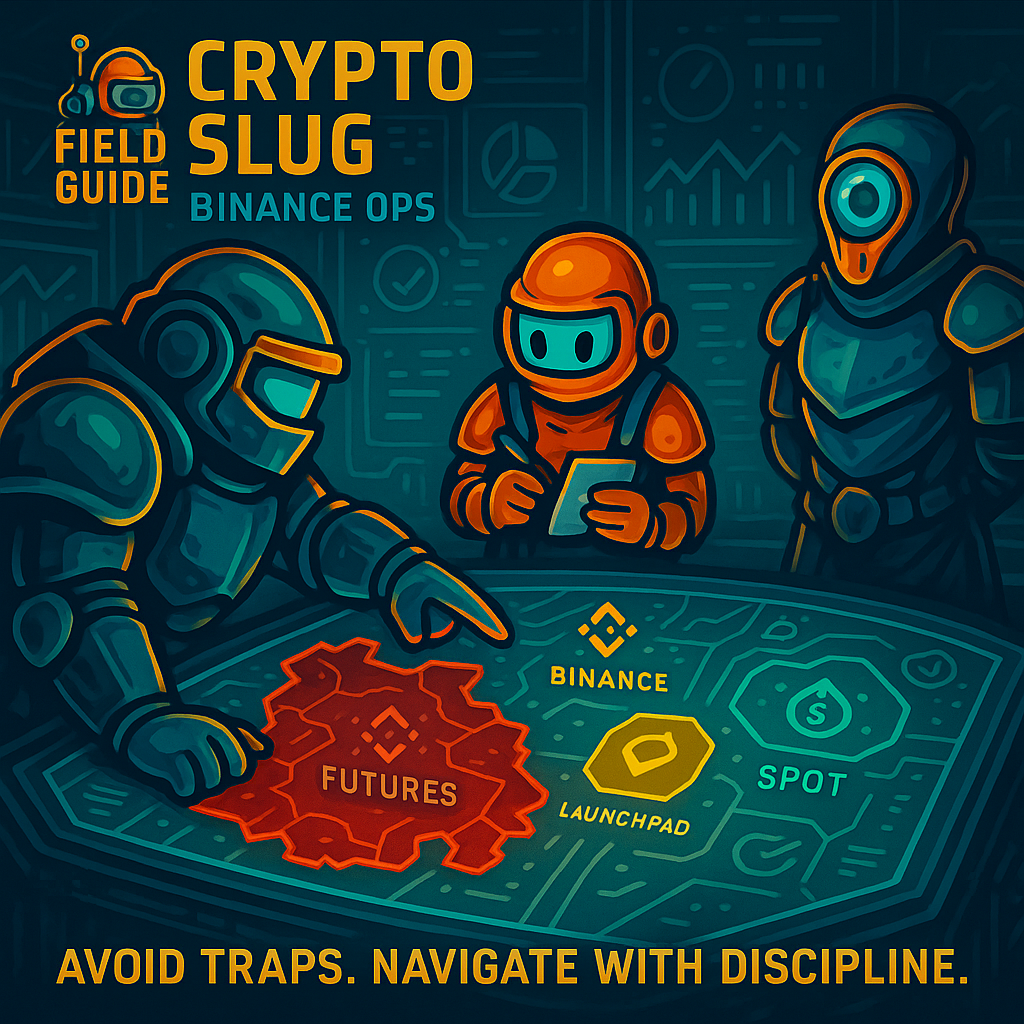
1. The Binance map in trench language 🗺️
When you first open Binance, it feels like a cockpit full of blinking lights. To think clearly, it helps to see the platform as a set of main “districts”:
- Trade / Spot – where you buy and sell crypto directly.
- Convert – simplified Spot (no order books).
- Derivatives / Futures / Options – leverage, contracts and complex products.
- Earn – the “yield” zone: staking, savings, auto-invest, etc.
- Finance / More – Launchpool, Launchpad, loans, cards, rewards.
- P2P – direct trading with other users, outside the order book.
🧭 Navigation rule: anything involving leverage, derivatives or returns that look far above average should be treated as a red zone until proven otherwise. Simple, reversible products that you can explain to someone in 30 seconds sit on the relatively safer side.
2. Red zone: services to avoid at the beginning 🔴
This is where most beginners get hurt. The problem is rarely “bad luck”; it's the mismatch between product complexity and user experience.
2.1 Futures (Perpetual, USDT-M, COIN-M, etc.)
- They allow leverage (X2, X5, X20, X100…).
- You can be liquidated: the position is force-closed and you lose nearly everything you used as margin.
- They include funding rates, Cross vs Isolated margin modes and an easy path to being over-exposed in seconds.
A single wrong click with the wrong leverage can wipe out months of savings. Even when there is early “luck”, it is terrible for discipline.
2.2 Margin (Isolated / Cross)
- Lets you borrow funds to increase position size.
- In Cross mode, a drop in one asset can eat into the margin of your other positions.
- There is real margin call and liquidation risk.
In practice, it's the same poison as Futures, just disguised as “Spot with turbo”.
2.3 Leveraged Tokens (LT, 3x, 4x, etc.)
- They look simple: you buy “BTCUP”, “BTCDOWN” and get built-in leverage.
- They use internal rebalancing mechanics that can destroy value over time, even if price moves “your way” in choppy patterns.
If you can't explain on paper what happens in different price and volatility scenarios, it's not a suitable product to start with.
2.4 Options, Dual Investment and complex structured products
- Options: calls, puts, greeks, implied volatility, expiry dates.
- Dual Investment: you commit to buying/selling at a future price and may end up with assets or prices you didn't really want.
- Other structured products: shiny names, lots of “if X then Y” conditions.
Here you are trading conditions, not just price. Details matter, and a small misread of the fine print can be very expensive.
2.5 Copy trading, built-in trading bots and “magic signals”
- Profiles with impressive PnL numbers inviting you to follow automatically.
- Pre-configured bots with yield promises.
- Strategies you don't control and metrics you can't truly audit.
Delegating risk without understanding the system is a classic recipe for disaster. First you learn the terrain, only then you consider automation.
2.6 P2P without experience 🧨
- Direct deals with other users (bank transfers, apps, etc.).
- Requires attention to payment methods, timelines, disputes and reputation.
Without prior experience, the risk of scams, chargebacks and frozen accounts is real. Binance is mostly an arbiter here; the counterparty is a person, and people can lie.
3. Relative green zone: safer products to start with 🟢
“Safer” does not mean “risk-free”. Market risk — prices dropping — never disappears. But at least you don't multiply it with leverage or opaque structures.
3.1 Buying crypto in a simple way: Convert and “vanilla” Spot
- Convert – you choose the pair (for example, EUR → BTC), see the quote and confirm. No order books, no advanced modes.
- Simple Spot – you buy BTC/ETH/USDC using “market” or “limit” orders, without margin.
Good practices:
- Start with small amounts compared to your overall bankroll.
- Stick to Spot without margin.
- Focus on major assets (BTC, ETH, stablecoins) until you have a solid plan.
3.2 Simple Earn Flexible (flexible savings)
Products where you “deposit today and withdraw when you want”:
- Available for USDC/USDT, BTC, ETH and other supported assets.
- You receive interest daily or periodically.
- In most cases you can redeem without long waiting periods.
Risks:
- Platform/exchange risk (Binance is not a bank account with guaranteed deposits).
- Asset risk (if a stablecoin breaks or a crypto collapses, the interest won't save you).
For beginners, this is often the simplest way to avoid leaving everything idle without jumping straight into aggressive products.
3.3 Simple Earn Locked (staking / locked)
The “lock for X days” version:
- You choose an asset (ideally blue-chips) and a period (30, 60, 90 days, etc.).
- You receive higher APY in exchange for not touching those funds until the end.
Good practices:
- Only lock a portion of what you hold in that asset.
- Never lock funds you might need for emergencies.
- Read the product description carefully, especially if there is DeFi under the hood.
3.4 Auto-Invest (automatic DCA)
A tool to run DCA (Dollar Cost Averaging) mechanically:
- You define an amount (for example, 20 €/week).
- You choose the assets (for example, BTC + ETH).
- Binance buys automatically at those intervals.
Advantages:
- Reduces the temptation to “hunt for the bottom” before every buy.
- Builds discipline if you refrain from constantly tweaking the plan.
Risks:
- It is still full market exposure: if the market drops 70%, the portfolio follows.
- Never use money you can't afford to lose.
4. Other ways to earn tokens on Binance 🎁
Beyond interest and regular buying, there are ways to earn extra tokens. Some are fairly clean; others require very tight brakes.
4.1 Launchpool (stake and earn new tokens)
- You stake BNB or stablecoins into a pool.
- You receive tokens from a new project over time.
- You normally keep the asset you staked and receive the new token on top.
Watch-outs:
- New tokens can be extremely volatile.
- Don't assume “because it came from Launchpool, it's guaranteed to go up”.
4.2 Launchpad (more advanced)
The mechanics vary, but in general:
- You use BNB/stablecoins to participate in a token offering.
- You receive an allocation if you are selected or according to the event rules.
It's more advanced and competitive. If you're still in early stages, it makes more sense to observe how it works before considering participation.
4.3 Rewards Hub, Learn & Earn and tasks 🎓
- Watch videos, take quizzes and do small tasks to receive tokens.
- Time-limited campaigns that reward trying out features.
Sensible approach:
- Only go for tasks tied to simple products (KYC, 2FA, quizzes).
- Avoid tasks that push you into Futures, Margin or leverage just to earn cents.
4.4 Cashback, cards and similar 💳
- Some cards linked to Binance offer crypto cashback on everyday purchases.
- They allow you to build exposure almost “invisibly”, which can be a double-edged sword.
If you are still learning to manage risk on the exchange itself, it might not be wise to mix supermarket spending with crypto volatility right away. First master the basics, then decide whether connecting cards makes sense.
5. Practical plan for your first month on Binance ✅
To tie everything together, here is a simple and realistic plan:
- 1) Set up your defenses first: enable 2FA (TOTP), anti-phishing code, withdrawal address whitelist and review all security settings.
- 2) Turn off temptations: avoid opening Futures/Margin accounts and ignore banners with absurd yields and products you don't understand.
- 3) Start small in Spot: make occasional (or DCA) buys in major assets, with amounts that won't keep you up at night.
- 4) Explore Simple Earn Flexible: put a portion of your stablecoins or blue-chips into flexible mode and observe how interest works.
- 5) Evaluate, don't chase: when you see Launchpool, Launchpad and similar, read, take notes — don't jump in just because “it ends in X days”.
- 6) Use your own log: write down every decision (why you bought, how much, exit plan, risk taken) to build awareness and discipline.
6. Conclusion: Binance is a map, not a shortcut
Binance is a giant platform: it has relatively safe areas, training zones and corridors full of psychological traps. If you enter through the wrong door, you walk away thinking that “crypto is a casino”. If you learn how to read the map, it becomes just a tool inside a bigger plan.
☑️ Final message: start with simple Spot and flexible/locked Earn, stay away from leverage and structured products until you know exactly what you're doing and log your decisions. The goal is not to get rich quickly; it's to avoid dying early.
More on cryptoslug.pt — Gunbot strategies, automation & discipline.